Black Gold of Haryana
Murrah
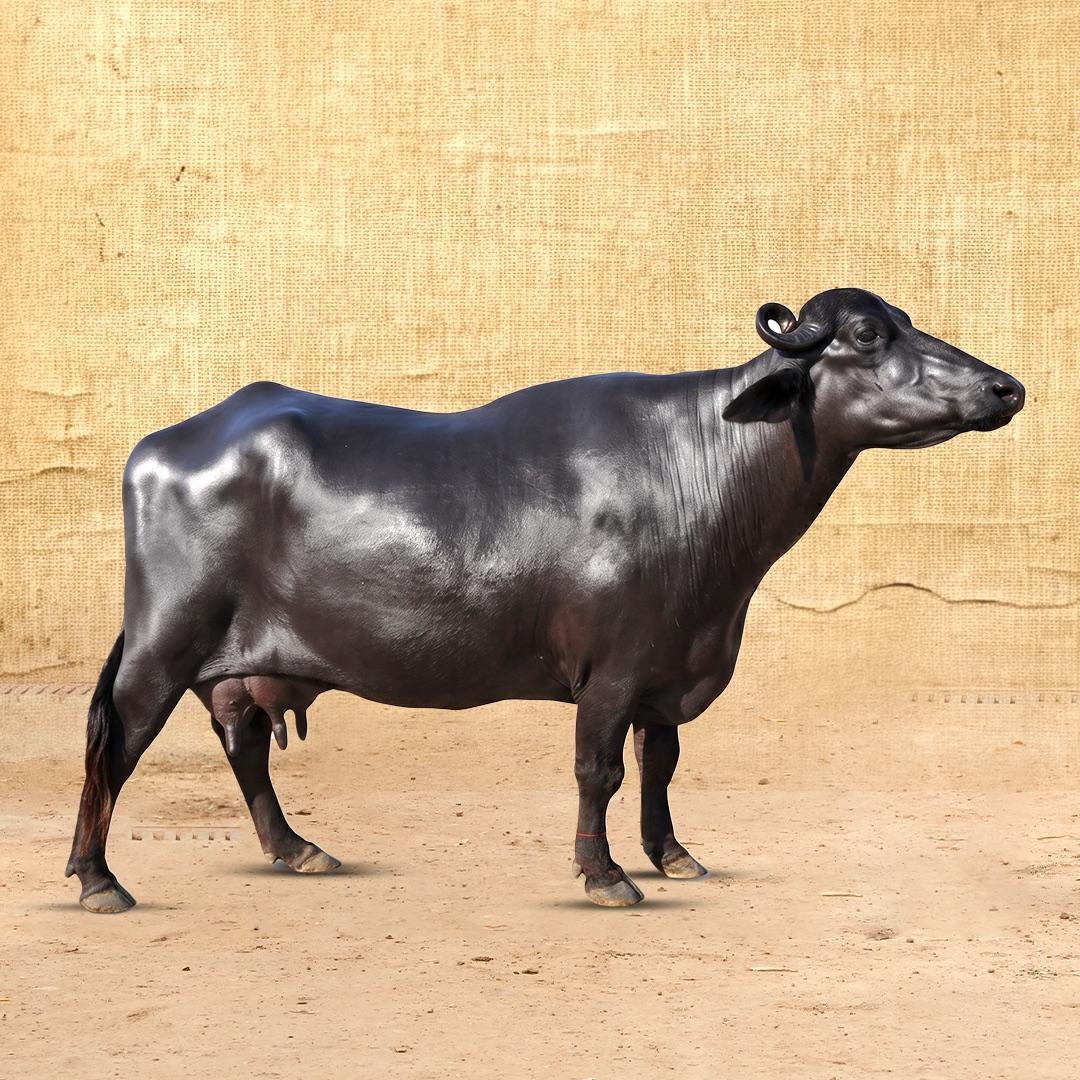
Murrah is India’s most important dairy buffalo: jet black, with tightly curled horns and milk that averages over 7% fat. It is also the breed behind much of India’s pioneering buffalo IVF and cloning work.
Water buffalo · Bubalus bubalis (river type). Jaffarabadi is a buffalo breed, not cattle.
- Jet-black coat
- Tightly curled horns
- High-fat milk
At a glance
Two kinds of number, side by side: what this breed typically gives under good management, and the national breed average recorded by ICAR-NBAGR across every kind of farm.
- Litres a day, good management
- 8–12
- Hebbevu’s typical range
- Per lactation, national average
- 1,752 kg
- ICAR-NBAGR breed average
- Milk fat
- 7.3%
- Female body weight
- 516 kg
On organised farms, 305-day yields run from about 1,370 to 2,090 kg, with peaks of about 10 to 11 kg a day. The milk is also rich in solids-not-fat, at about 9.4 to 9.8%.
Getting to know the Murrah
Where it comes from
Hisar, Rohtak, Gurgaon and Jind districts of Haryana, and Delhi. It has since spread to almost every part of India.
‘Murrah’ means curled, after the breed’s horns.
DelhiKundiKaliHow to recognise it
- Coat
- Jet black. White marks on the face or legs are rare and not preferred.
- Horns
- Short and tightly curled in a spiral.
- Build
- A massive, wedge-shaped body with a long head and neck, a well-developed udder and broad hips.
Size
- Female
- 516 kg
- Male
- 567 kg
- Female height
- 133 cm
- Male height
- 142 cm
Average adult size, ICAR-NBAGR.
Strengths in the field
India’s most widely used dairy buffalo, for milk rich in fat
Built for
- Suited to stall-feeding on seasonal fodder: berseem, oats and mustard in winter; sorghum, pearl millet and cluster bean in summer
- Adapted to a wide range of conditions, from Haryana to the south
- Few sweat glands, so it needs shade, water or a wallow in hot weather
Used for
- Milk
- Meat
- Males for breeding and draught
Around the world
Murrah, and India’s buffalo IVF firsts
Murrah is established in Bulgaria, the Philippines, Malaysia, Vietnam, Brazil and Sri Lanka, among others. Bulgaria imported Murrah from India between 1962 and 1990 to upgrade its local buffalo.
India has led buffalo reproductive science. The world’s first IVF buffalo calf was born at NDRI Karnal in 1990. In 2015, CIRB Hisar cloned a superior Murrah bull, and in 2022 it produced a calf by OPU and IVF using that clone’s semen and an elite female.
- Bulgaria
- Philippines
- Brazil
- Malaysia
- Vietnam
- Sri Lanka
Breed records
The published facts in one place. Averages, not guarantees. Individual animals and well-run herds can do far better.
| Record | Murrah |
|---|---|
| Species | Water buffalo · Bubalus bubalis (river type) |
| Native tract | Hisar, Rohtak, Gurgaon and Jind districts of Haryana, and Delhi. It has since spread to almost every part of India. |
| Also known as | Delhi, Kundi, Kali |
| Typical daily yield, good management | 8–12 litres/day |
| National average per lactation | 1,752 kg (range 1,003–2,057 kg) |
| Milk fat | 7.3% |
| Milk type | A2 (Murrah tested in Tamil Nadu were all A2A2) |
| Age at first calving | 43 months |
| Calving interval | 14.9 months |
| Female weight | 516 kg |
| Male weight | 567 kg |
| Population | About 1.17 crore pure and 3.66 crore graded Murrah in India’s 2013 breed survey. |
What to know before you choose
Plan for late maturity
First calving comes at about 43 months and the calving interval is about 15 months. Heifer feeding and fertility management decide the profit.
Watch for silent heat
In summer, buffaloes often show no outward signs of heat. Give shade and water or a wallow, and watch closely so insemination is timed right.
Check the bull, not just the name
Most ‘Murrah’ in India are graded: 3.66 crore graded against 1.17 crore pure in 2013. Use semen from progeny-tested Murrah bulls with published breeding values.
Is this the right breed for you?
Choosing the right breed is the foundation of a successful dairy operation.
- 01How hot and dry does it get on your land?
- 02Can you hold feed quality through a bad season?
- 03Does your market pay a premium for A2 milk?
- 04How close is your nearest competent vet?
Sources and other breeds
Sources (10)
- ICAR-NBAGR breed registry (AGRI-IS)
- NDDB Dairy Knowledge Portal: Murrah
- ICAR-CIRB Buffalopedia: Murrah
- Kumar et al. 2019, Indian Journal of Animal Sciences: Murrah performance review
- Kathiravan et al. 2023, Indian Journal of Animal Research: A1/A2 in cattle and buffalo
- Napolitano et al. 2023, Animals: heat stress in buffalo
- ICAR: CIRB clones a superior Murrah bull (2015)
- ICAR: OPU-IVF calf from the cloned bull (2022)
- ICAR-CIRB: Murrah in Bulgaria
- The Tribune: NDRI and the first IVF buffalo calf
- National averages come from the ICAR-NBAGR breed registry and the NDDB Dairy Knowledge Portal.
Interested in Murrah genetics?
Tell us about your herd and we will help you decide whether this breed, and IVF, makes sense for you.